It’s a mad world

31 10 2004
I discovered something unique today. A former Linden Labs employee has made a Schizophrenia simulation in Second Life (if you’re a player, click here to go right there).

It features a walk through a hospital ward with voices telling you “You’re dead!”, “Kill yourself!”, as well as visual halucinations and a little information as well. It’s disturbing, it’s educational and it makes me thank the heavens I have most of my sanity.

What an intersting thing to build and what an interesting project to undertake. Second Life beautifully suits this kind of education and I applaud Nash Baldwin, aka, James Cook, for his work.


Multiplayer only on my terms?

31 10 2004
Second Life recently saw the birth of a strange lifeform. A green cube called ‘Zombie’. This cube, when touched, multiplied, and as it did so it would move towards and hunt down players. If a player had a reasonably high velocity gun they could shoot these cubes and overcome the evil zombie menace.

The brain behind this amusing Halloween stunt was Lordfly Digeridoo, an experiences and creative Second Life member. However, having released his multiplying zombies into the wild of Second Life they took on a life of their own and became quite hard to remove, each deletion often spawning another zombie. This combined with a general lack of awareness of what these things were about resulted in many negative ratings and abuse reports for poor old Lordfly!

A few days later he is still racing around deleting Zombies and apologizing. Yet for some this isn’t enough.

While the idea was grand we can probably all agree the implementation was a bit off. Having the zombies wild in the large world meant a lot of confusion for people who hadn’t read Lordfly’s posts and clues on the boards and, well, some people are just plain touchy.

But what I don’t understand is how he has gathered such broad negative reaction. Second Life is by its very nature a creative medium and one where a lot can go wrong, simply because of the freedoms we are given. Why are people so touchy over virtual content that is virtually meaningless? I love the idea of this code gone native and out of control, I think it’s fun and interesting on many levels, yet some people just get upset if someone in any way interacts with them on a level they don’t agree with.

Perhaps this is a legacy of the internet generation. With everything at our fingertips and on demand we no longer have to watch, listen or deal with anything we don’t like. A closed window, a deleted email and the problem is solved. That people are so quick to judge and complain I find somewhat disturbing. What does it mean for the future if this is the kind of behavior seen in your friends, your neighbor’s, your family. Real world society could see people in neighborhoods even more isolated and alone than they are already, only seeking solace in social internet experiences they can tightly control. But Second Life isn’t an extension of the internet, perhaps it is, strangely, more like real life, with its mix of the uncontrollable, the strange and the downright annoying. Hopefully it will always be a slightly chaotic convergence of wild ideas, optimism, creativity and sometimes, zombies.

Is it a bird? Is it a plane?

30 10 2004
No, it’s an ornithopter! Another of Cubey’s creations and flies as good as it looks. It constantly amazes me the kind of creativity and ingenuity Second Life inspires. It’s an active medium, not a passive one, and that’s exciting.


Skydiving Pirate!

30 10 2004
Skydiving Pirate!
Skydiving Pirate!,
originally uploaded by Calistas.
I kitted myself out with a parachute, skydiving gear, helmet and goggles and enjoyed the great experience of skydiving in Second Life!


Blastoff!

29 10 2004

Second_Life_Rocket
Originally uploaded by Calistas.
Had some great fun toying around with objects I bought today in Second Life. This rocket launches you high into the atmoshphere and then ejects you at a set altitude. I’ve yet to purchase a parachute, but th trip is still a lot of fun!


Building DarkLife

27 10 2004
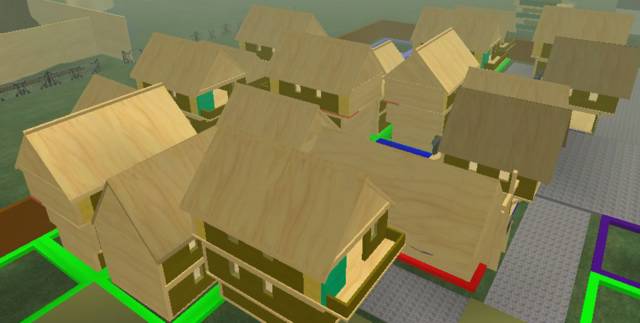
The construction of the town of Navora for second life continues. It is taking time but there is a lot to do. So far the mockups are looking fantastic and we are all looking forward to seeing the town ‘live’, as it were.


When is theft fraud, or exploitation?

27 10 2004
This discussion over at the Second Life forums is about a situation where a player seems to have accidentally sold some land for $0 to another player. This player ‘pounced’ on the land sale, probably with a script, and then immediately sold the land on to a willing buyer (or alt?). With the Linden Dollar being valued at around $1.20us per L$250 that represents for the player a loss of around $380us of virtual property.

Is it so hard to imagine a future when these games become popular enough for thieves to make a nice sideline income from scamming players. As the real virtual value of goods becomes more accepted and acceptable will games companies be done for aiding and abetting if they don’t work very hard to track and stop these kind of exploits? Should the police, or the small claims court be involved? Maybe one day. For now we just have forums and a rather accommodating Linden Labs to keep us happy.


DarkLife is reborn! All Systems Go!

24 10 2004
DarkLife is reborn! The amazingly fun experience Mark and I first created in Second Life is coming back. You can read all about it on the Second Life forums. We can’t wait to see it all happen and we’re looking forward to launch day in arond 6 weeks (maybe less). We have a huge area devoted just to DarkLife, imagine what we can do with it?


Toying around in Second Life

24 10 2004
I had a good bit of time in Second Life just now, waiting for my collaborators to appear online. While I was hanging around I went off and did some exploring. Finding some plane shops I picked up a couple of units. This beauty works both underwater and in the air and has extending wings when in flight and so-on. Clever work and fun too! Thanks Cubey Terra for a great plane!


Dad’s new car.

23 10 2004
My dad has gone and bought himself a new (second hand) car. It’s a Smart car by Mercedes and they are not yet released in New Zealand. It does about 100k (60 miles) on 4lt. (1 gallon) of petrol and has all sorts of other wizzyness about it. Dad tells us he bought it to make a statement!

Dad’s new car! 


Some news from Second Life

23 10 2004
It is looking quite likely that we’ll see some action on the DarkLife front. This is exciting for Mark and I as the project is a lot of fun and people respond very well to it. I’ll post more news when I can.


What is a game? The fate of the world is in your hands!

21 10 2004
What is a game? Why do people play them? Where does the obsession for them come from that we see in so many people? First, lets think about what a game is. A mathematical definition is that games are:
A model of a competitive situation that identifies interested parties and stipulates rules governing all aspects of the competition, used in game theory to determine the optimal course of action for an interested party.

The mathematical definition is my favorite because it reaches close to what I believe the essence of what a game is. However, I believe this particular definition misses something, or at least doesn’t highlight it enough. A game involves a series of choices within a rule set and these and subsequent choices can often be predicted. It is the interplay between the rules and a series of choices that ultimately makes a game involving to players, an interesting mental diversion. This is because the visible boundaries to our actions (created by the rules) and the generally finite, often predictable choices combine to produce a comforting and secure realm of possibility where we have almost complete control, unlike the real world.

An ancient game like chess is perhaps the best example of how rules and choices combine. The rules are simple and clear and the choices on each turn are finite. That the range of choices a player has ranges from zero to dozens on each particular turn (depending on board state) is one of the fascinating aspects of the game. However, above all other principles it is the finite and controllable nature of this world that underlies its appeal. For example chess puzzles in newspapers are popular because, bound by the rules, there is a ‘solution’ to a problem that simply requires analysis. That chess and similar games are ancient only highlights for us how natural it is for man to enjoy making choices in a controllable and controlled environment where success and failure are rewarded based on our clear thinking.

Of course, the real world is not so easy to contain or predict and you may be as likely to lose as win, regardless of your strategy. Perhaps this is why, as the world seemingly grows more chaotic, there is increasing interest in games of all kinds. War, famine, economic upheaval are instantly reported and the plights of millions who had no choice to participate in world events are piped directly into our homes. Games give us back control and we can find worlds at our fingertips. While we are bound by the rules we are expected to eventually succeed and our success empowers us with feelings of a job well done. We can have complete control, we can predict the outcomes and we can plan in advance to achieve them. This explains why we are often more relieved than surprised when we do succeed at a game.

If we accept that games give us control and this is compelling then why is it that massively multiplayer gamers seem the most dedicated? Online games are more unpredictable than offline ones right? And yet, across all kinds of games, computer, card, casino, board, there would hardly be a more dedicated group and multiplayer online gamers. Everquest players average around forty hours play time a week and this figure is likely to be broadly similar for other games in the genre. While many computer gamers play a lot I can’t imagine many non-MMOG games are played as often as Everquest. Yet, if we think about the appeal of games a reason becomes more apparent. MMOGs are set within a world that can be controlled and predicted and where success is rewarded by public recognition.

While randomness exists it is often the most loathed part of the game and intensive efforts are made to remove it. MMOG gamers are able frighteningly capable of predicting battle outcomes, devising the most efficient strategies and organizing to achieve the highest successes. For many people this is a lot more satisfying than the real world where success seems so far away and hard to reach. The playing field is level in an online game and time and a nominal fee are all that are required to compete. In the real world it may seem impossible to achieve outcomes equal to one’s peers, not so in an online world. In an online world we can experience the success we want and we can make this evident to other living, breathing, human beings. Your CPU doesn’t care if you just completed a 3 month quest arc, other people, however, are impressed, reinforcing the player’s feelings of success and self-worth. Why else do people shout ‘ding!’ when they level a character and enjoy a round ‘gratz’ and ‘well done’? Social affirmation of success, success built through results driven by predictable choices are what make MMOGs incredibly compelling.

Perhaps it would be interesting to study how many hard-core multiplayer online gamers feel they’ve had more real-life successes than online ones? I can only hypothesize that the more hard-core the player the less rewarding real life has been. Conversely, those who play infrequently or quickly get bored of MOGs may find that real-world successes are simply more satisfying and so essentially chose these rewarding experiences rather than ‘imaginary’ ones. How a person defines success would also be fascinating to compare to their online behavior.

What does this mean for our future? Perhaps as the complexity of online worlds increase many people will increasingly shun the real world. After all, it is entirely possible to make a living through playing online games and most bills and needs can be satisfied with a bank account, a credit card and an internet account. Why struggle in the real world when the online world can lead to more predictable success?

If this trend continues will we see the real world change as our societies respond to the changing expectations of the citizens? Will complex systems such as government and law be broken down to less complex systems to encourage participation? Perhaps a reluctance to involve oneself with anything overly complex or unpredictable will slowly erode mankind’s ability to innovate? Perhaps I should stop eating cheese before bedtime. Have a think and let me know!


Second Life blog: aLife and sLife

20 10 2004
Phillip Linden, one of the Second Life founders, has a nice blog entry on “aLife and sLife”. Emergent systems are already being seen in Second Life and they are a fascinating part of the code being written by users. To date most of these systems have been fairly one-dimensional (objects that wander around and act like vacuum cleaners, or objects with simple talk scripts), however the potential for objects that interact with other objects and with users is nearly unlimited. I hope some coders are inspired and we see some fun experiments!


Second Life, no! DarkLife, yes!

20 10 2004
Second Life is a unique world created by Linden Labs. It’s a world with content and purpose entirely defined by the players. Last year a friend, Bram, and I worked on a project to make and build a working roleplaying game inside this world. Titled DarkLife it was one of the few really strong interactive projects and we had a lot of interest and support.

In the end we both got too busy to support it and we let things slide before we completed the project. However, we’ve both got a bit of time again (more importantly, Bram does, as he’s the coder!) and we’re getting back into Second Life to get Dark Life going again. It will be an interesting experiment!


Adrian is great!

20 10 2004
Adrian, an old arty chum of mine, has graciously let me use some of his
web space to host the odd image and whatnot for this blog. This should
help me make it a bit more interesting! Thanks Adrian! If you’ve never
seen Adrian’s art you should go here and have a look, he’s a talented artist, website designer and general all-round creative god. Hire him!


About Netconcepts and my new job.

19 10 2004
NetConcepts is my new employer. NetConcepts is an interesting company that specialises in helping companies get visible on the web via search engines and whatnot. There’s also some great email marketing guff and other technological wizzardy. Worth a look!


Dominions 3 coming!

19 10 2004
My new current favorite game, Dominions 2, is expecting a sequel. Kind of predictable really but still enjoyable. You can read the Press Release for some more info on Dominions 3.

If you haven’t tried the game yet you really should if you enjoy good strategy gaming. The best part is you can easily play it multiplayer either by email or by connecting to a server and playing your turn when you have some time. Very cool!


First post!

19 10 2004
Welcome to my blog. If you’re reading this you probably know me as there is little reason to be here otherwise! Anyway, I don’t mind. This blog will be a nice way for me to track various interests, hobbies, curriosities and other bits and pieces that interest me. Along the way I will maybe entertain some folks with some random bits and pieces.


Bad Behavior has blocked 395 access attempts in the last 7 days.